Monday, 21 April 2014

Task 6C Award Title

Thinking about what award title to have has been a difficult process for me. Already gaining a Trinity Diploma in Professional Musical Theatre at Italia Conti and working as a professional performer singing, dancing and acting, I have lots of experience and knowledge on this subject, so choosing the follwing title would be a straight forward option :

·         BA Hons Professional Practice (Musical Theatre)

·         BA Hons Professional Practice (Performing Arts)


However, throughout my performing career I have taught singing for many establishes companies and worked within primary schools as a Teaching assistant gaining vast experience teaching pupils from the ages of 3-18 years old. My current professional practice is based working with foundation stage pupils (aged 3-5 yrs) where I have found a true passion to persue a career in teaching.  I wish to use my BA Hons Professional Practice degree to complete a  PGCE/QTS course to enable me to become a fully qualified teacher, if it be in Performing Arts or Early Years.  So, I have thought about creating my own title:

·         BA Hons Professional Practice (Performing Arts & Teaching)

·         BA Hons Professional Practice (Performing Arts & Early Years)

 
However, involving ‘Teaching’ and ‘Early years’ to my award title restricts the possibilities for future opportunities,  if I keep it to just ‘Performing Arts’ its left open to develop all areas of singing, dancing and acting. Also with all my past experience in performing it would be a shame not to credit the years I’ve spent doing it. I have chosen a line of inquiry that link both my passions together and as a final result  I personally feel the best award title for me is:

·         BA Hons Professional Practice (Performing Arts)


Award Title Rationale Draft:

Having gained a Diploma in Professional Musical Theatre and worked professionally as a performer singing, dancing and acting I feel I have lots of knowledge and experience within this field.  Through out my professional career I have always had a passion for teaching. Currently teaching singing to pupils aged 3-18 yrs I use the skills and techniques I have gained from my training and performing experiences to enahnce my teaching style and method.

As well as peforming experience I have worked as a teaching assistant in a variety of educational settings working with pupils aged 3-18 yrs. Within this practice I have gained a true passion in foundation stage teaching.  Following my BA Hons professional Practice degree I wish to persue a PGCE/QTS course to enable me to become a fully qualified teacher if it be within early years or performing arts  as they are both my passion. This title will provide many career opportunities for the future if it be in teaching or performance related.  Within this course my aim is to develop and improve my already established skills within my chosen field using varied and previously unexplored media and techniques, that help me achieve and fulfill future targets within education and employment.


Task 6a & b


Looking at Reader 6 and exploring different research tools for inquiry I think a qualitative method is better for my line of inquiry. With my line of inquiry being aimed at a target audience e.g. people who work with early years it’s best to use my contacts such as work colleagues and friends who I have a good relationship with in order to conduct an in depth interview for better results and evidence.


Using my everyday professional practice as an early years teaching assistant/singing teacher as a basis for my inquiry allows me to observe pupils I work with closely on a daily basis to notice the effects music and movement have on the pupil’s development, if it be via a learning activity or continuous play. With this participant/insider researcher method I need to be aware of a bias outcome for my inquiry so I need to consider the negatives as well as the positives music and movement have on the effect of a child’s development.


The important matter of using my primary school for research evidence is gaining trust and permission from the head teacher and fellow teachers for their co-operation to take part in an interview and the permission to use child development recorded progress data. I arranged a meeting with my Head teacher before carrying out any trial interview for my inquiry to ask her permission to allow teachers to participate. Once I got her permission I asked Emma a reception teacher her permission/consent to take part in my inquiry by signing a consent form. All evidence and data used will be sensitive to the participant and kept confidential especially pupil progress data, pupils names will not be used. If I need any photographic evidence of observational evidence e.g. pupils taking part in a music and movement activity, the Head teacher explained I need parental consent if the images are used outside the school setting and not to use children who are under safeguarding agencies. To overcome this issue I need consider selecting a small group of pupils whose parents wouldn’t mind me allowing their child to participate and create a parental consent form explaining the line of inquiry and to allow their child to participate and be photographed strictly for university purposes.


Deciding on the research tools of ‘Interview’ and ‘Observation’ I carried out a trial interview with a fellow colleague/friend whose a reception teacher. I decided to record the interview as an audio as I want to keep the participants identity confidential. The interview was carried out as a semi-structured interview, participant was aware of inquiry topic and given questions so they could prepare informal answers. This method was successful and produced great evidence which supports the inquiry question that music and movement helps early years development, it also opened up new ideas for me to explore and research further to develop my inquiry.


Below is a link to the transcript of the trail interview that took place (I have signed consent for using interview answers) :
 
https://drive.google.com/file/d/0B1neTV59axJFbUNmN1MtQVk3c1E/edit?usp=sharing


Monday, 7 April 2014

Task 5d Ethics

Today I discussed my research tools for my inquiry with teachers at school (SIG) and what the ethical considerations in conducting these tools. I aim to conduct an interview with teachers and complete a series of observations on pupils as well as looking at child development data to support evidence/research.

Please see below my brain storm of ethical standards I have to consider for a fair inquiry:


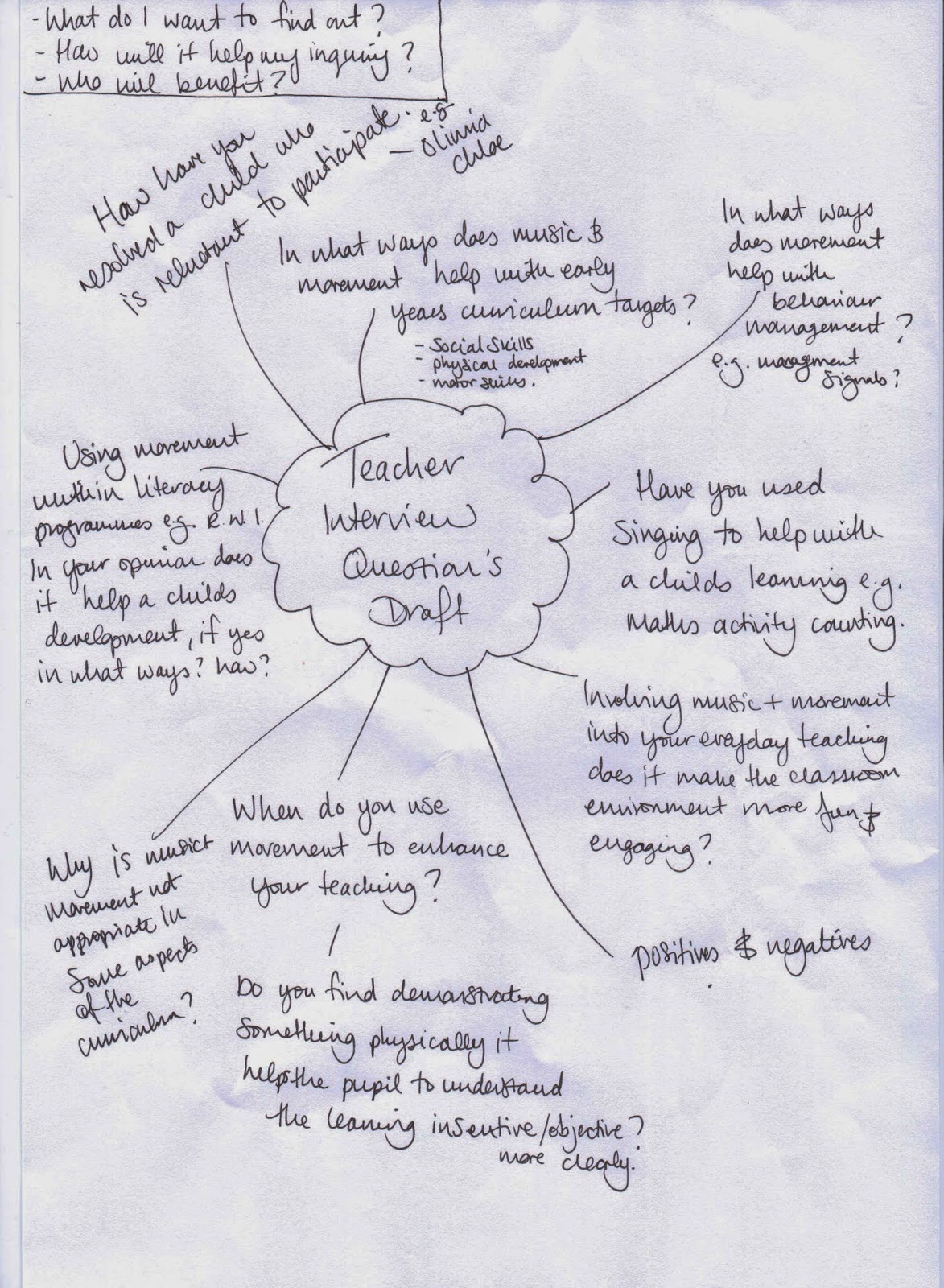
Taking one of these areas of ethics, I used my SIG group in work to help me explore possible questions for the content of my interview. It helped me discover what do I want to find out? and how will this help my inquiry? Below is some example interview questions for teachers;


Task 5c Ethics

After reading through Reader 5 on ethics I was able to abstract ideas and theories to help with my ethical approach for my professional inquiry.


There are many areas of ethics but the reader emphasises the importance of the following;

·         Personal

·         Professional

·         Organizational


I can relate to these areas within my profession as a teaching assistant and singing teacher by linking it to my area of inquiry. With my inquiry question being;


“What value does the use of music and movement have when, used by teachers, carrying out a learning activity and does this method enhance different aspects of a child’s development within early years?”

 
I will use my own personal ethics learnt from family values and society expectations to enable me to conduct a fair, safe inquiry that will keep participants evidence safe and confidential with full consent from all parts to participate. Choosing to do an inquiry within a school setting I have to consider the professional ethics e.g. the school’s code of conduct and policies. The policies and codes of conduct must be strictly adhered to in order to protect agreed participants e.g. teachers, colleagues and pupils.

 
The first case study within the reader makes you question where do the ethical principles lie? And who is responsible? When conducting a research inquiry you have to consider the ethical matters across the spectrum e.g. pupil’s, head teacher, my position within the school? You have to consider Personal, organizational and societal factors.


Virtues

The Reader touched on the importance of ‘Virtues’ and how people view ethics. Hobbes viewed ethics as;

“A practical solution to social harmony, and good through the vehicle of a social contract. He positioned that in order to achieve peaceful, co-operative social order we need to adhere to a set of moral rules”
(Hobbes (1961) Reader 5)


Theoretical Approaches

Reader 5 explained theoretical approaches to ethics these are;


·         Consequentialism: an act is morally right if, and only if, that act maximises the good.


·         Deontology: only absolutely good thing is a good will hence motive behind an action determines whether or not it is morally right, ethical action based on duty.


·         Virtue: the character of the moral agent rather than the rules or the consequences and what actions taken reveal about one’s character. Moral behaviour and character as important as action.

(Reader 5 BAPP 2013/14)

 
Comparative Ethics

People hold differing notions of “good”. With the growing society and expanding ethical cultures people have a different view and value to what is “good”. Society contains differing conventions and customs which have brought new practices and social norms. Looking at my own professional practice the school curriculum is always updating and improving to incorporate new strategies to benefit pupil’s learning and progress. As a teaching assistant I have to adapt to change and embrace new techniques and methods to conduct learning activities that will benefit pupil’s development.

 
“Whatever in any city is regarded as just and admirable is just and admirable in that city for as long as it is thought to be so”

(Plato


I can link this quote to my professional setting e.g. teaching style, teaching strategies, behaviour strategies etc. We adapt to the changes of society to in co-operate modern society e.g. technology.


Professional Ethics

 
I have to consider the following;

·         Code of conduct

·         Tension within frameworks

·         Employer expectation; Professional code/ personal ethics.

·         Attribute to profession:

-          Need permission from senior staff

-          Classroom decisions

-          Learning activity decisions

-          Follow policies for effect practice

-          Safeguarding/ Behaviour/Health and Safety policies.

-          Adhere to contract of employment.


Ethical Problems


·         Metaethics

·         Theoretical normative ethics: moral axiology, virtue ethics, theory of moral obligation.

·         Applied ethics.

 
Alan Durrant's Lecture on positionality helped me understand this in more detail please see my blog on campus lecture notes:


Alan Durrant’s blog on ethics goes into great detail on this topic as well:


Looking at ethical theories within Reader 5 has made me consider all the areas of ethics that link to my professional research inquiry. This has helped me approach my inquiry considering the ‘ethos’ and morals of all participants and evidence collected.

Sunday, 6 April 2014

Developing inquiry question.

I've been drafting my question many times over the last couple of weeks, not sure what direction I want to go, but I feel I've come up with a question I'm happy with to base my inquiry on as it links my singing teaching work with my early years teaching assistant work. My inquiry question is: 

"What value does the use of music and movement have when, used by teachers, carrying out a learning activity and does this method enhance different aspects of a child's development within early years?"

I would really appreciate any comments and opinions to help with my inquiry.

Thanks 

Monday, 31 March 2014

Campus session 3 (25th March)

The main theme of the session was 'Knowledge'. Paula led the session we started by discussing the different themes we've looked at in the other campus sessions these were;
  • Searching
  • Theorising
  • Love
We looked at different points of view on knowledge e.g. constructivism, philosophy, Dewey. Looking at different points of view enables you to add knowledge on to what you already know.

We discussed about what is 'Knowledge'? Paula described 'Knowledge' is situated in individual contexts. We then went on to think about who has knowledge? Where can we find knowledge?

As an activity we drew a 'Body of Knowledge' and filled it in with what we considered as our knowledge.

This is my diagram:


Alan said;  "We construct our own knowledge" This led us on to discuss how having knowledge will help us with our inquiry process:

What do you want to know?
  • Find knowledge
  • Explaining and reporting
  • Using knowledge to inform practice.
Your knowledge is constantly changing, knowledge and understanding is informed by your context.

Paula showed a quote from Mezirow (1991);

"Learning is to bring about change and transformation."
 
Paula explained how we use Knowledge within the BAPP course. We looked at tools such as social science inquiry tools e.g. framework within context. Paula explained the 'Knowledge' is trans-disciplinarily it has different areas. Paula showed two quotes;
 
"Knowledge is narrative and per formative, only true to the time being."
Lyotard (1984)
 
"Treated knowledge as discourse ideological discourse of the powerful"
Foucault (1972)
 
We talked about the arguments for knowledge, and helped us think about what kind of knowledge and understanding are you gaining? What else have you learned?
 
Below is the process we take when planning an inquiry:
 
1. Networking- Reflection
 
2. Planning- Rehearsal
 
3. Doing the Inquiry- Staging your work
 
Second part of the lecture we had a discussion with Alan about any aspects of the modules we were worried about. We discussed ethical issues of peoples inquiries and looked at how we plan our inquiry, an example of this is;
  • Set Aim
  • Title
  • Explore/Objectives
  • How you're going to analyse?/ what method?
  • Ethics/ actions perceptions.
Alan has wrote a post about 'Ethics' if anyone wants some ideas on how ethics link to their research inquiry. 


Ethics Task 5b


Many of my assumptions regarding ethics within the workplace were similar to the codes of conduct/policy handbook my school follow for ethical frameworks. I also looked at the ‘Bera’ ethical guidelines for conducting a research inquiry within an educational setting.


In my earlier post when I brain stormed various aspects of ethics within the workplace I concentrated on more the pupil’s welfare, however reading the schools handbook it is important to consider ethical practices of  staff members e.g. teachers, T.A.’s and Management team.


A strong emphasis within the school’s code of conduct/policies handbook were Employers, students and teachers within the workplace should be treated fairly, sensitively, dignity, ethic respect and freedom from prejudice. Teachers, T.A.’s and staff have a duty to safe-guard and promote the well-being of pupils in their care.


The school have a ‘Whistle blowing’ policy. This allows employers to report to appropriate manager any impropriety or breech of procedure e.g. neglect of duty/role. The school have an ‘Interest disclosure Act’ which allows staff to report a disclosure to the Head teacher to protect themselves.  


The school (workplace) have practice expectations they need to adhere to. They maintain this standard through regular safeguard training and knowledge awareness of procedure/policies. Every staff member has the same professional standards regardless of culture, disability, gender, language, racial origin, religious belief and sexual identity.


Looking at safeguarding practices staff members have a duty to keep young people safe and protect them from sexual, physical and emotional harm. Staff must be vigilant in treating children with respect and dignity and at all times consider the child’s best interests.  The key aspect of this is ‘confidentiality’. When working with children or using children within a research inquiry you must maintain informed consent and use anonymous treatment. You have got to consider Child protection issues, safeguarding issues and data protection. ‘Bera guidelines’ state that; “inquiry involving/concerning children, the interests of the child must be primary consideration.”


Looking at the workplace ethics there’s a big emphasis on different aspects of staff ethics these are;

·         Staff are responsible for own actions and behaviour.

·         Staff to avoid putting selves in vulnerable situations.

·         Staff to be aware of expectations, policies and procedures.

·         Clear about when information can be shared and in what circumstances it is appropriate to do so.

·         Be discreet and act in a confidential manner when handling pupil data.

·         ‘Need to know’ basis when sharing concerns/ confidential data, avoid potential breeches of confidentiality.

·         Teachers/staff are in a position of trust.

·         Staff must consider their behaviour outside the workplace, and avoid excessive alcohol/drugs use as this may have a big impact on their responsibility working with children. Within the workplace you are a role model and are expected to demonstrate positive behaviour this includes activity on social media sites and use of the internet and uploading appropriate photos.

·         Always maintain professional boundaries between adult and pupil.

·         On social networks set profile to private settings and approved contacts, never give personal details to pupils and except them as friends.

·         Don’t discuss work related matters or identify individual staff members, children/families on social websites.


I didn’t consider dress and appearance within my first blog, this is important because being a teacher you need to dress appropriately. Don’t wear revealing or sexually provocative clothing. You need to demonstrate a healthy/safe lifestyle and good hygiene, you have to remember if you demonstrate a healthy lifestyle pupils will follow.


Web 2.0 has many complications when used within an educational setting you have to maintain confidentiality and appropriate information. You have to ensure pupils are not exposed to any inappropriate images or web links. We can protect pupils by blocking social media sites and particular sites like You Tube to prevent inappropriate images/videos be exposed to pupils. When taking images of pupils for pupil progress you must use school approved equipment and store images on a safe database with restricted access.  


Working with children you have to consider physical contact and what’s considered acceptable. Physical contact must take place in an open environment and pupils must give permission for example; the use of physical contact may be used to demonstrate a correction or support the use of a certain piece of equipment e.g. scissors. Staff must adhere to the school’s code of conduct and policies when it is appropriate for physical contact for example you may need to control a pupil to prevent harm to another child e.g. behavioural management, staff who carry this out will be trained efficiently and follow procedures strictly to not put themselves at risk.  


In summary there are lots of ethical considerations within a school setting, you have staff and pupils welfare to consider. By following ethical frame works, code of conduct and school policies ethical standards will be maintained and adhered to strictly.